THIRD QUARTER, AUGUST 2026 VOLUME 40, NUMBER 2
Newsletter By Dave McCracken General Manager
Quite a few members have visited Happy Camp< and/or spent time on our numerous mining properties during the 2026 season. As far as we can tell, the California Department of Fish & Wildlife has only cited a single miner for suction dredging along the Klamath River and tributaries this season. That person is not a New 49’er member and has not approached us for advice or legal assistance.
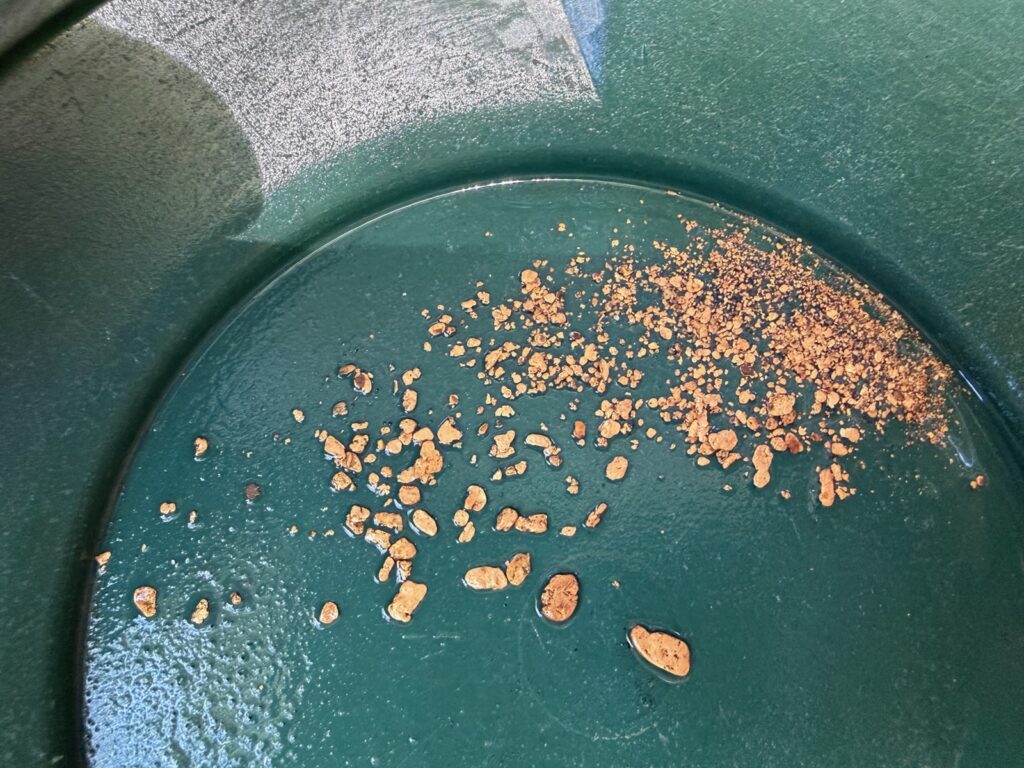
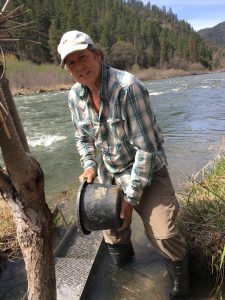
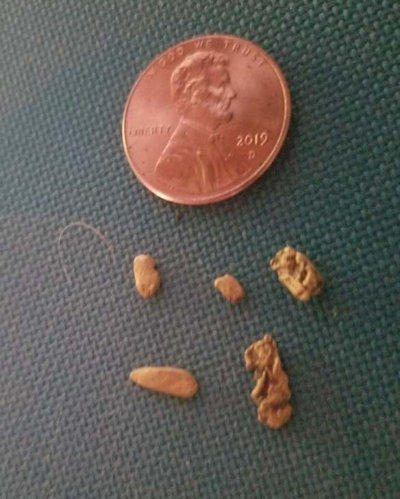
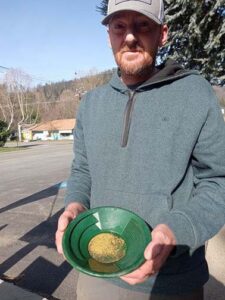
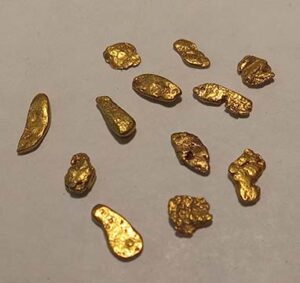
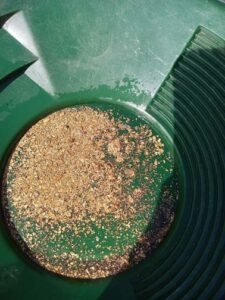
Golden treasure being dredged on the Salmon River this season
I will cover our views about the legal consequences of suction dredging on our properties as a New 49’er member in the section below. Suffice it to say that most underwater mining is happening along the side tributaries in areas that are not as visible to the open road. Even though we have now won against the three dredging citations that have been written against New 49’er members during the last two seasons, the legal cloud of the possibility of getting into trouble (for a while) is generally undesirable to most honest folks.
We will eventually get it all sorted out. I personally expect the gold prices to perhaps double again during the next upswing, which might even happen before next season.
The gold prices have about doubled since last season and look to be starting the next upward trend after a pause. The Klamath River is as low as I have ever seen it and is running much clearer than last season. This creates a whole new area of surface mining alongside both sides of our miles of river that were not accessible before.
We have pushed our potlucks up to every other week on Saturday evenings. While there are not as many attendees as we had during the glory days before suction dredging was shut down, there have been enough people to make them fun and entertaining, with plenty of good food.
Let’s face it. The world is a mess. A strong strain of communism has infiltrated the U.S. Democratic party. There is also a strong trend whereby people, and even government officials, believe that their own political leanings justify ignoring legal rules that have been adopted according to our constitutional principles. This affects us directly as outlined below.
The U.S. is involved in a war against Iran for multiple reasons; and even though we have thoroughly defeated them on the battlefield, it is definitely not in their nature to ever give up. The war between Russia and Ukraine that is killing more than a thousand soldiers per day does not appear to be getting closer to a final resolution. China continues to threaten Taiwan. Now Japan is beating war drums against China. America is still spending two or more trillion Dollars a year in excess of how much it brings in per year. Our national debt is pushing 40 trillion dollars not counting Medicare, Medicaid, Social Security and future military and civil service retirement obligations. Our ongoing interest obligations (on the $40 trillion national debt) exceeds what we pay on national defense. In fact, we are now printing money to pay our own interest. This is called a “doom loop.” No country in the history of the world has recovered from a doom loop!
While there are some good things also happening, they are mostly overshadowed by the downward trends.
I’m sorry to burden you with bad news. But I believe it is wise to carefully consider and plan for the actual world that we live in. Trillions in more money printing is certainly going to cause more and higher inflation.
On that note, something I have never seen in any news cycle is the reality of how inflation compounds. To verify my awakening to this, I asked from the artificial intelligence on my smart phone. This is very important to understand: When it is reported that we have an annual rate of 5% inflation, I think it is normal to consider that this is a 5% loss of purchasing value compared to some point in the distant past; like the way things “used to be years ago.”
Inflation is actually continuous and cumulative. For example, an average of 5% inflation this year will reduce the purchasing power of a Dollar to around 95 cents during that single year. Then, 5% inflation next year will further reduce the original purchasing power down to about 90 cents over the 2-year period. And it keeps going hour by hour, day after day, year after year as we keep spending more than we bring in.
So when investment advisors announce that a 6% fixed interest rate on a 10 year bond or other paper investment is good, because you will ultimately get paid $1.06, when inflation is running at 4%, they are overlooking the cumulative affect inflation will have on the purchasing power of your dollar over 10 years. Even the smartest financial advisors are not talking about this.
Increasing gold prices over time, more or less, reflect how much value has been stolen (hidden tax) from our money, mostly due to money printing. By printing $2 trillion dollars this year to meet our ongoing interest obligations, if my calculation is correct, with 5% inflation, we will add 10 billion more dollars to our mandatory interest payments next year.
Said another way, America is killing itself. If it wasn’t so serious, it would almost be humorous to hear our politicians running on the platform of “making things more affordable.” It is not going to happen!
Just possibly, those of us who place our savings in precious metals may have a chance of surviving what is coming. This includes investing in the ability to go out and mine for your own gold.
In my view, there are two hopeful considerations that might come out of the current trends:
(1) The value of gold is going to go up as the value of paper currencies declines. This is good for those of us who invest our savings into precious metals. Money saved in the bank or hidden under your bed is losing a small amount of purchasing power every day.
2) I am hopeful that as things get more painful, eventually a bigger portion of our population will come to terms with reality. Honest reality really works for our industry! It is totally unreasonable and anti-American to prevent us from freely harvesting gold off the bottom of our rivers when there has never been any proof that our cumulative activity has ever harmed fish! The truth (reality) will eventually catch up with the insanity and it will be on our side. It has to. Mostly, it is about how much pain we need to suffer as a society before we face reality. It is not just us that are facing the insanity. It is everywhere! So even though present circumstances don’t look so great, I believe it is all going to turn much better for us in time.
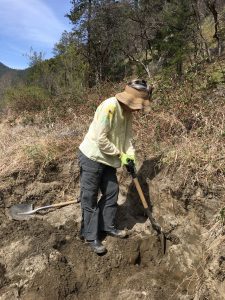
Meanwhile, gold prices have doubled since last year, we have a lot of gold mining property available to us, camping is free; and our members are getting good prospecting results above or alongside our waterways, or even on the bottom of the waterways using methods that are comfortable to them.
Note that thousands upon thousands of Americans survived the great depression with little more than a gold pan. If gold doubles in dollar-value again this next year, a pennyweight will be worth $400 or more.
Ongoing Legal Explanation from the New 49’er Legal Fund
First of all, thank you sincerely to all of you who contributed to our Legal Fundraiser last season. We raised enough money to support all of the miners and members who requested assistance, mostly on the matter of suction dredging. So far, we have not lost a single case.
Tucker’s second suction dredging citation by the Department of Fish & Wildlife (for the same offense which was defeated by Tucker the first time) under a different code sub division of California Section 5653 was defeated in Siskiyou County Court a second time by Tucker. He accomplished all of that completely on his own! Since we are not aware of any rulings in Siskiyou County that have penalized suction dredgers, we are still assuming that suction dredging under a partnership, corporation or other organization (Section 5653.8) remains legal in Siskiyou County. It appears that they have refused to honor Siskiyou Counties’ Superior Court Decisions because DFW has continued to write several citations and seize dredging equipment. Note that the deep state refuses to honor Decisions made against them from the very same judges that they expect to penalize us!
We need to watch carefully the situation where our law enforcement agencies choose to ignore the very same laws they are imposing upon us. What kind of government would not respect the Decisions of it’s own justice system? Are we there, yet?
DFW issued a citation to Gerard Buggey in September of last year for “possessing a suction dredge within 100 feet of a closed waterway” (5653(e). Through quite a lot of time and expense, determined to defend himself, Mr. Buggey submitted a substantial Motion to Dismiss to Siskiyou County (not the same judge that decided Tucker’s cases early last season). Mr. Buggey’s hearing took place over a Zoom call on or around 8 July of this year. After some back and forth, over the DA’s objections, the judge Decided to place Mr. Buggey on a 1-year deferment scheme; which, if I understand it correctly, places the charges against Mr. Buggey on hold for one year. If Mr. Buggey does not get into trouble during the next year, the charges against him will be dropped and his dredge will be returned to him.
We were hoping for an immediate dismissal; but sometimes you have to take what you can get. The most important part of this hearing, from my perspective, was when the DA was arguing that Mr. Buggey’s dredge should never be returned to him. The judge responded by throwing up his hands and sternly instructing the DA that the suction dredge regulations are so confusing and complex that no person of average intelligence should be penalized for not understanding them. This was, almost word for word, one of the primary arguments made in Mr. Buggey’s Motion to Dismiss.
Meanwhile, DFW continues to ignore the Siskiyou County Superior Court’s Orders. Here is their latest press release on the matter.
Because a lot of time and money went into Mr. Buggey’s defense, we are publishing a cut & paste version of his Motion to Dismiss right here:
https://goldgold.com/wp-content/uploads/2026/07/Motion-To-Dismiss-REDACTED.pdf
This motion includes all or most of the important legal arguments for defending suction dredgers from DFW’s maligned intent to ignore their own regulations.
Perhaps, sooner or later, DFW will stop harassing honest, hard-working Americans that simply want to earn a sustainable living on the public lands. Even a pennyweight of gold these days is worth $200! The volume of a pennyweight is about the size of an eraser head on a pencil.
Annual Dues is Billed This Month
We bill all Full Members $50 for annual dues in August. September through the end of the year is when we must shoulder the load of increased property taxes and filing fees to the County and Bureau of Land Management. These are legal requirements which allow us to continue making a substantial number of federal mining claims available to our members.
In real terms, the true value of the gold along these extensive properties may be worth more than the net assets of any financial institution on the planet (who are dealing mostly in paper assets). Especially these days when the government is printing trillions upon trillions of Dollars out of thin air. The dollar-value of our gold and mining properties has doubled during the past year!
I remind you every year that we should be calling our extensive properties the “Klamath First National Bank.” Ours is the only bank in the world where you can go out, set up your own camp, and make a draw anytime you wish. There are no interest, rent or bank fees to pay. And you never have to pay the gold back! This is as close as it comes to an opportunity to maintain some degree of personal freedom during these ever-more difficult and troubling times. Not to mention that we are located smack in the middle of some of the best Pacific Northwest country you will ever see. As far as I know, we are the only organization in the world that makes a very large bank of pure wealth freely available to our members.
Having said that, governments (California, Oregon, Washington and others) have imposed unreasonable regulations upon our industry. Basically, they are arguing that we no longer have the right to excavate or process minerals using motorized mining components within 100 yards of an active waterway. All of our other traditional mining methods are still available to us.
We have not given up hope that American policymakers will eventually wake up to the fact that our natural resources are what will fuel the economy of the future if we want to be prosperous. This goes for farming, ranching, timber, mineral, oil and natural gas development. Since this is an important election year, I urge you to vote for leaders that support natural resource development. You know, “Drill baby drill!”
Note that despite 40 years of cumulative inflation, we have never increased the annual dues cost upon our cherished members. As long as you guys continue to stand with us, we will continue the fight for our basic freedoms. There remains hope that America will wake up and realize that we need to produce value and wealth in excess of what we consume. The mindset that we should all get everything we want without having to work for it will only increase the downward spiral of America. That so many people have locked themselves into this mindset is a strong symbol of how far we have slid into the abyss of national bankruptcy.
We all know that these are troubled times for America. The whole world hangs in this balance. If conservatives win control in the upcoming elections, it would not be unreasonable to hope that we can win our country back. Then we might be able to win our industry back. There remains some reason for hope.
I am willing to invest my personal resources to keep our program going as long as you guys, our members, are also willing to hang in there until we overcome what is destroying America, or it becomes clear that there is no longer any hope. My assessment of your support will be in what percentage of Full Members are willing to invest $50 a year to help keep our dream alive: The freedom for Americans to go out on the federal lands and invest your personal energy and resourcefulness in exchange for all the gold you can find.
We should do all we can to maintain our Klamath First National Bank. If lost, we will never get it back! We are enormously lucky to have access to it. Thank you very much for your continued support over the past 40 years!
Dave McCracken, General Manager
New 49’er Gold Prospecting Association
27 Davis Road P.O. Box 47, Happy Camp, California 96039 (530) 493-2012
www.goldgold.com

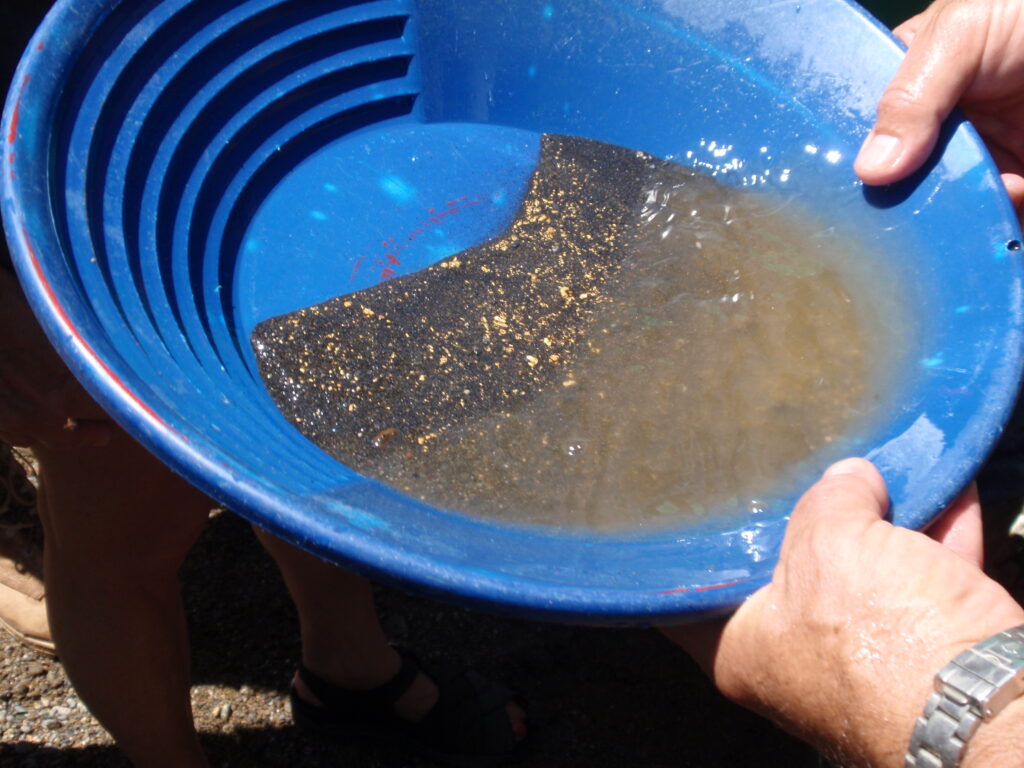





 Story by Eric Spitler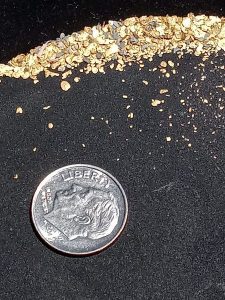
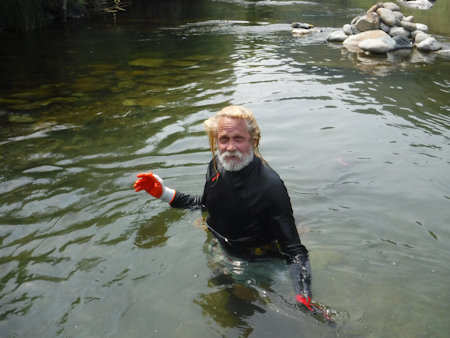
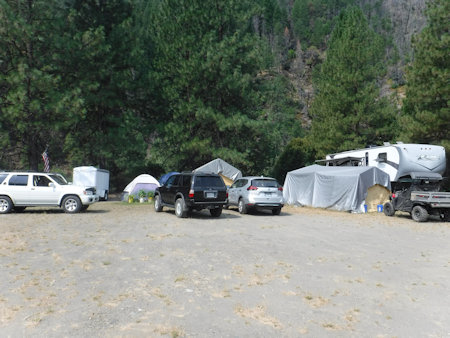 Several years ago, Dennis lost a pretty serious contest with a large boulder that ultimately broke one of his legs in six different places. After surgery put his leg back together, Dennis returned to Hawaii to do some healing. He says he was a complete invalid for at least six months. I’ll bet! The following season, Dennis returned to
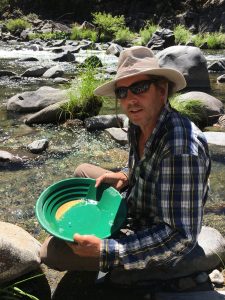
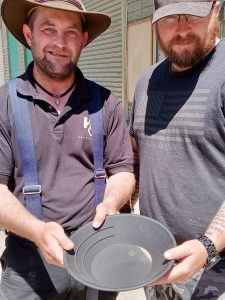
 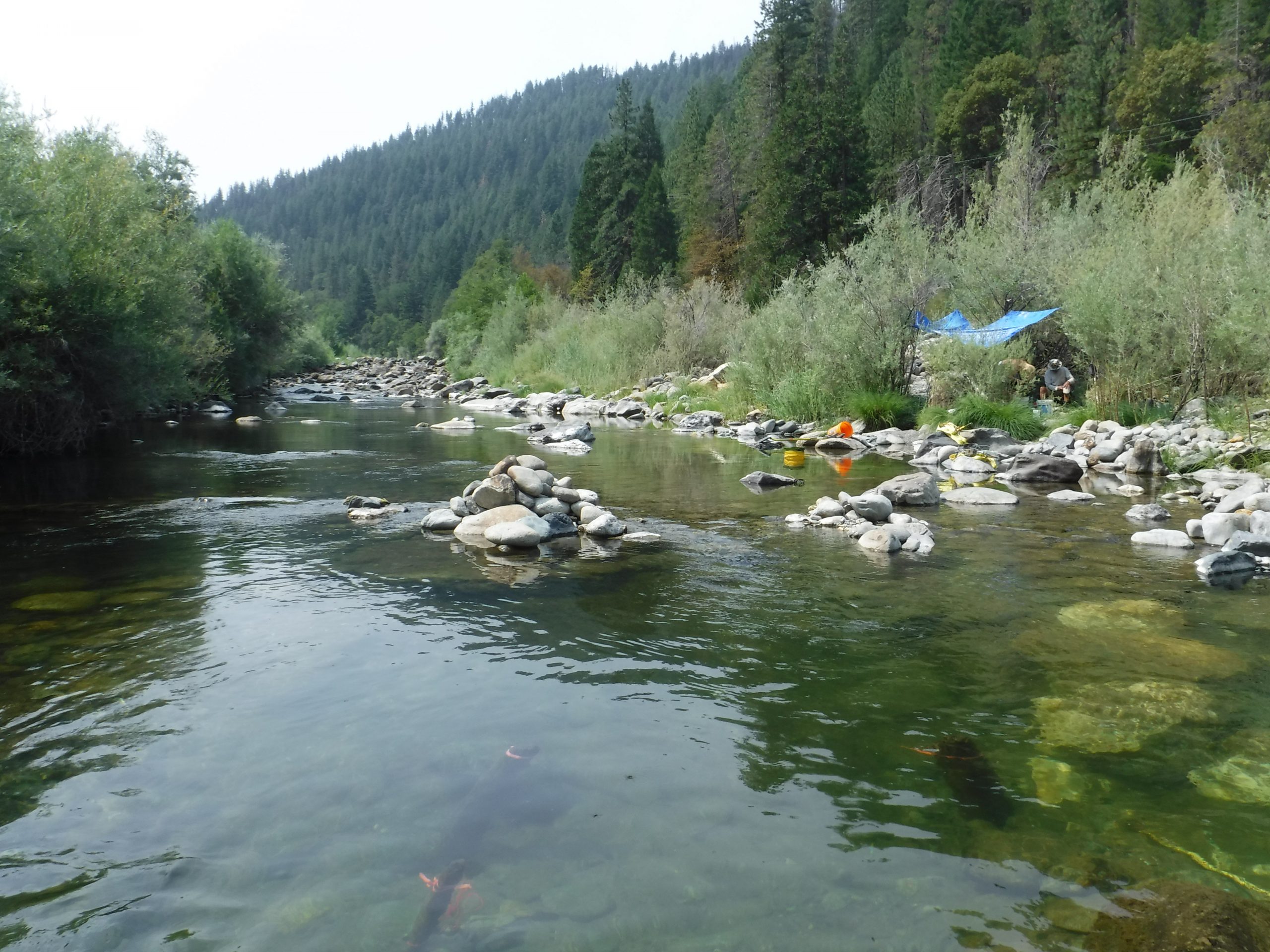 I paid a visit to Dennis Kim several mornings ago, because I heard that he and his mining partner, Brent, also from Hawaii, have been recovering nice gold using hand methods inside the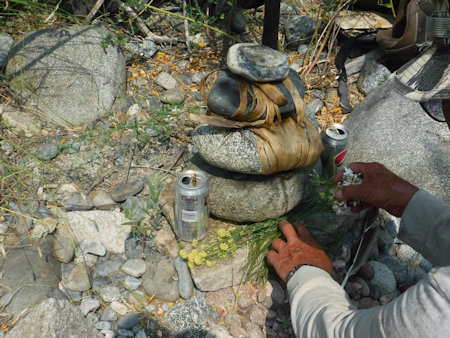

 Story and images by Betsy Anderson & Eric Spitler